
Cats are wonderful pets. In fact, they outnumber dogs as pets in the United States. It is estimated that 60.2 to 62 Million cats are kept as pets; one-third of all households have at least one feline friend. It is important for cat owners to be aware of a stealthy disease that may affect as much as 15 to 20% of all cats.
Heart disease is one of the more common problems in the cat, and can affect cats of all ages. Some causes of heart disease may never cause the cat any symptoms; some can cause severe signs, even sudden death.
By far the most common heart disease in the cat is hypertrophic cardiomyopathy (HCM) accounting for at least 60% of all heart disease in the cat. This is an excess thickening of the heart muscle walls, so much that it interferes with the pumping action of the heart. The walls can even get so thick that the ventricle chamber is greatly reduced in size, and therefore only a small amount of blood can be pumped with each contraction.
Cats with mild HCM may never show any symptoms, but more commonly cats with HCM develop one of three scenarios: congestive heart failure, clot formation, or sudden death. Cats do not cough with congestive heart failure as dogs do; cats in heart failure have a fast respiratory rate and labored breathing. If you study their sides, you can see they are using their abdominal muscles to help them breathe. You may notice they do not want to lie down in a normal manner, they sit sphinx-like and are reluctant to move.
HCM cats are prone to clots. These form within the heart, and can break off and are swept by the blood stream to other areas of the body. The clots can go anywhere, but most commonly they go down the aorta and lodge where the arteries divide to go into the rear legs. You will find these cats unable to use their rear legs and crying in pain. Your veterinarian will be suspicious of such a clot if the rear paws are cold, the femoral pulses are absent, and the pads of the rear feet are pale while the front pads are pink.
Cats with HCM may also die suddenly. They may act fine one minute, and die within seconds to a couple minutes. Death can be due to a severe arrhythmia or a clot that affects the brain.
HCM can develop sporadically in any breed or type of cat, but as it does have a genetic basis, certain breeds are prone to this potentially devastating disease. Maine Coons, American Shorthairs, Ragdolls, and Persians have a much higher incidence than most other breeds, but each of these four breeds has its own genetic variation of HCM. The Maine Coon and Ragdoll breeders have funded a veterinarian who does genetic research to develop genetic screens for their breeds. But, unfortunately each test works only for that breed for which it was developed.
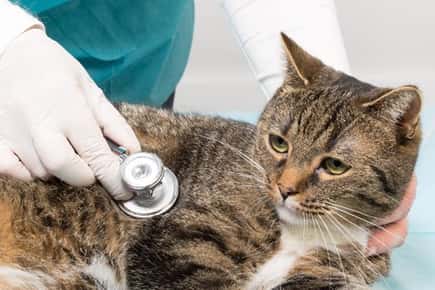
Regular examinations are important as your veterinarian will auscultate your cat’s heart (listen with a stethoscope) each time it is seen. A murmur means more investigation is needed. A murmur is just a symptom, it is caused by turbulence of blood not flowing in the normal manner. There are innocent murmurs, which means, there is a murmur but it is not clinically important, and will never cause the cat a problem. To make HCM even more difficult, one- third of HCM cats do not have any murmur at all.
Other tests that may be done are blood tests, especially a thyroid test, and proBNP, which is a newer test to check for cardiomyopathy. Blood pressures and chest x-rays may also be done, especially if fluid in the lungs is suspected. Radiographs (x-rays) of the heart are not useful, as severe heart disease can be present while the heart looks normal, but x-rays are needed to check the lungs.
The most important test to diagnose heart disease is an echocardiogram, which is an ultrasound of the heart, and needs to be performed by a veterinary cardiologist. With an echo, the internal structure of the heart can be seen, and measurements taken of chamber size, valves of the heart observed for leaks with Doppler, and a diagnosis made.
There is no cure for HCM, but there are various drugs used to try to manage the disease. Diuretics are used if they have started into failure; also atenolol, diltiazem, and enalapril have been used, although no studies have shown great efficacy. Plavix, an anti-coagulant, is used if the heart is in the stage where clots are a concern.
There are other heart diseases that occur in cats: heartworm parasites, congenital malformations, restrictive cardiomyopathy, and dilated cardiomyopathy. The latter problem is much less common in the last decade since cat foods have been supplemented with higher levels of taurine.
In summary, regular examinations are important to keep your feline friend healthy. Your cat’s doctor will always be mindful of the potential for heart disease, listen for any abnormal sounds, and question you on any symptoms you may be seeing. Your veterinarian can help your cat stay happy, playful, and as awesome as ever!
References:
www.vet.cornell.edu/fhc
www.humanesociety.org
www.worldanimalfoundation.org/cats/how-many-cats-are-in-the-usa/